← Back to blog index · 2026-05-06
Why funding market is the Best USDT Yield Source (and Why a Bot Beats Manual)
funding market offers higher APR, deeper liquidity, and an open API that no other major exchange matches. Here's the data, and why a bot consistently outperforms manual offers.
If you hold USDT and want a yield source that actually keeps up with crypto-native interest rates, funding market is — by a meaningful margin — the best venue in 2026. This post unpacks why, with data from the last two years, and explains why running a bot is materially better than placing offers by hand.
What is this funding market?
The “Funding” market is a peer-to-peer lending pool. Margin traders borrow USDT (or USD, BTC, ETH) for leverage; you lend them your idle stablecoins and earn interest. You stay in custody of your funds the entire time — your USDT sits in your own funding wallet, and the platform just brokers the match.
Two key properties:
- You set the rate. Place an offer at the daily rate you want; the order book matches you against borrowers. There’s no fixed APY pool.
- Term is fixed at offer time. Loans run 2, 7, 30, or 120 days. The borrower can’t repay early, so you have certainty about how long your capital is locked.
If the market wants to borrow at 12% APR for 30 days and you want 14%, you sit in the book until either the market rises to meet you or you reprice down. Most yield platforms hide this — this venue makes the auction visible.
Why this venue beats Binance Earn, OKX Earn, etc.
Binance Earn / OKX Earn are convenient but yield-capped pooled products. They take a cut and rebate you a fixed APY (USDT 4-7% as of late 2025). Behind the scenes, the exchange itself is the borrower (lending to its own margin desk), so they have every incentive to keep the rate low.
The funding market is different in three ways:
| Dimension | Binance Earn / OKX Earn | The funding market |
|---|---|---|
| Rate-setting | Platform sets a fixed APY | You set; market matches |
| APR ceiling | ~7% USDT | 30-100% during liquidation events |
| Custody | Pool / opaque | Your wallet, on-chain auditable |
| API access | Limited | Full REST + WebSocket |
| Term flexibility | Mostly daily redemption | Choose 2/7/30/120 days |
The trade-off: this venue requires you to do something. You can’t just deposit and check back in a year. Rates move, offers expire, and during normal markets you’ll often see funding APR drop to 4-5%, which is below the platform-pool offerings. The advantage materializes during volatility — leverage demand spikes, and APR can briefly hit 30%, 60%, even 100%.
The headline number isn’t the average APR; it’s whether you were able to capture the spikes. That’s where bots win.
Two-year backtest: what does the rate distribution actually look like?
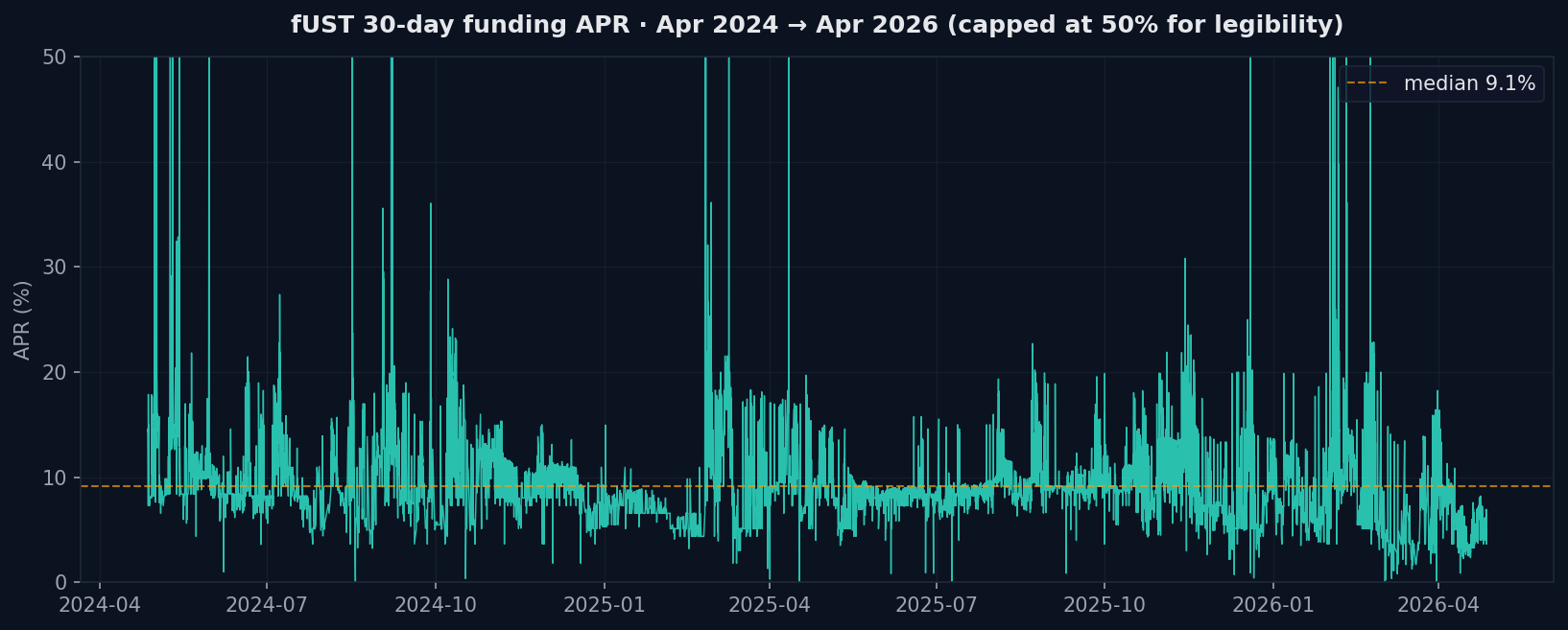
We pulled hourly funding candles from the venue’s public API for fUST (USDT) and fUSD (USD) from April 2024 to April 2026. The 30-day funding APR over that window:
Median sits at 9.1% with frequent runs to 20–30%, and the spikes you can see piercing the 50% cap are real, isolated events that briefly hit 200%+ APR. Here’s the same data sliced by period:
fUST (USDT) — daily rate × 365 (APR %)
| Period | Median | P75 | P90 | Max |
|---|---|---|---|---|
| 2 days | 5.84% | 7.66% | 12.0% | 200% |
| 7 days | 8.69% | 10.6% | 14.5% | 1095% |
| 30 days | 9.12% | 11.8% | 15.0% | 2403% |
| 120 days | 9.86% | 11.0% | 13.5% | 2427% |
fUSD (USD) — daily rate × 365 (APR %)
| Period | Median | P75 | P90 | Max |
|---|---|---|---|---|
| 2 days | 5.00% | 6.57% | 10.5% | 256% |
| 7 days | 7.47% | 11.0% | 14.0% | 271% |
| 30 days | 9.01% | 12.8% | 16.0% | 268% |
| 120 days | 9.86% | 11.5% | 13.5% | 274% |
The same data as a histogram makes the per-bucket shape obvious — short locks cluster near 5% while the longer periods push their mass past 9%:
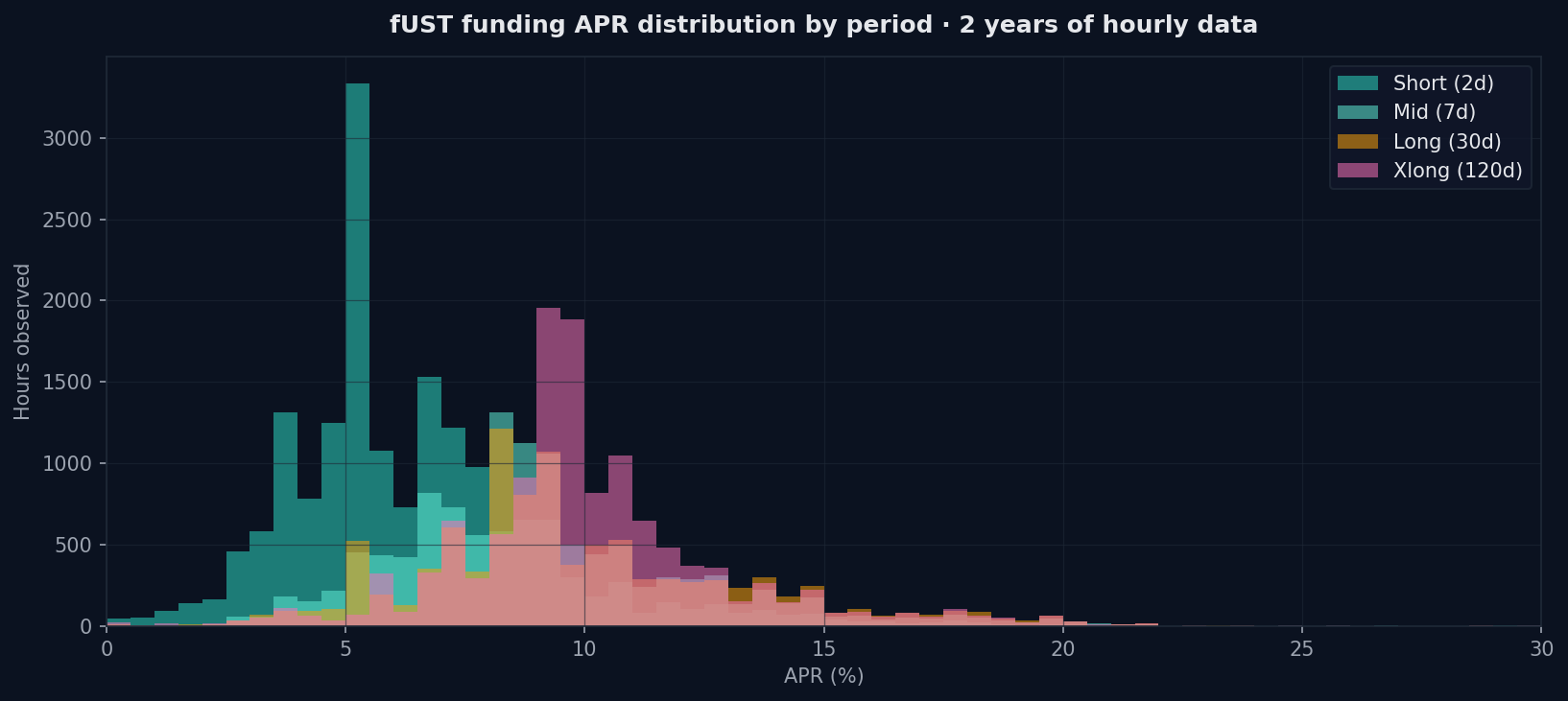
Two observations:
- Median ≈ 9%, P75 ≈ 11–12%. A naive lender who places offers slightly above market median will average 9–11% APR, comfortably above any pooled product.
- Long tail goes to the moon. Those 1000%+ readings are real — they happen during margin liquidation cascades. They’re brief (often a single hour), but if you can catch even some of them, your annual APY shifts noticeably.
The case for automation
Three reasons a human can’t capture this manually:
1. Spikes happen at 3 AM your time
Liquidation cascades on the venue don’t politely wait for office hours. The fUSD funding/fUSD 30-day candle hit 47% APR on a Tuesday at 04:00 UTC in late 2025; by 08:00 UTC it was back at 9%. A bot watching every minute catches that 4-hour window. A human watching the dashboard once a day catches zero.
2. Manual offers stale within hours
If you place a 30-day offer at 12% APR and the market drifts to 8%, your offer sits unfilled for days. The optimal behavior is to cancel and reprice — but that means watching the order book continuously. A bot reprices every 60 seconds.
3. Diversification across periods is hard by hand
The “right” answer to “should I lend 30-day or 120-day?” depends on the current rate curve, your wallet utilization, and your views on rate direction. Doing this analysis manually for each capital allocation is tedious; doing it consistently is impossible.
What a good lending bot does
A bot worth running automates four decisions:
-
Per-period floor. Each bucket (short / mid / long / xlong) has its own minimum APR. If the market dips below, the bot doesn’t lend. Without a floor, you’ll end up with capital locked at 4% APR for 120 days — exactly the scenario manual lenders fall into.
-
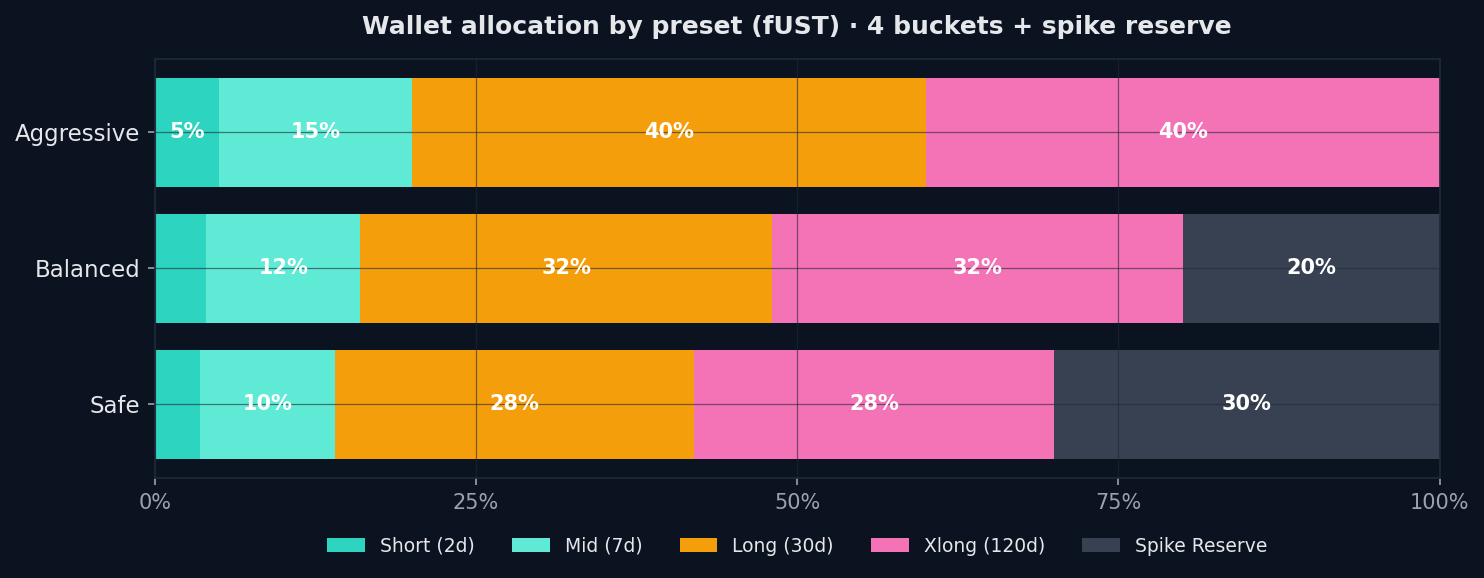
Allocation gap-fill. Targets like 40% of wallet in long, 40% in xlong, 5% in short, 15% in mid. If long is over-allocated and xlong is under, the bot only places into xlong this tick. This prevents the “all my capital is in 2-day buckets” trap.
-
Spike capture. When any bucket’s borrower bid crosses, say, 20% APR, the bot diverts a reserve pool to that bucket. This is the GRAB mode that captures the 1000% events.
-
Anchor-aware pricing. When other lenders are offering at 8.5% and the borrower bid is 9%, you don’t gain anything by sitting at 9%; the bot prices just below the cheapest competing lender so you’re at the front of the queue.
The combination of all four is what turns the venue’s wide rate distribution into a 12–14% APY backtest (70% of walk-forward median for marketing conservatism). None of the four is hard individually — but doing all of them every minute, every day, is what justifies the bot.
Yieldsforge’s approach
We built Yieldsforge specifically to encode the four behaviors above into a hands-off SaaS. Three preset strategies (2026-05 upgrade):
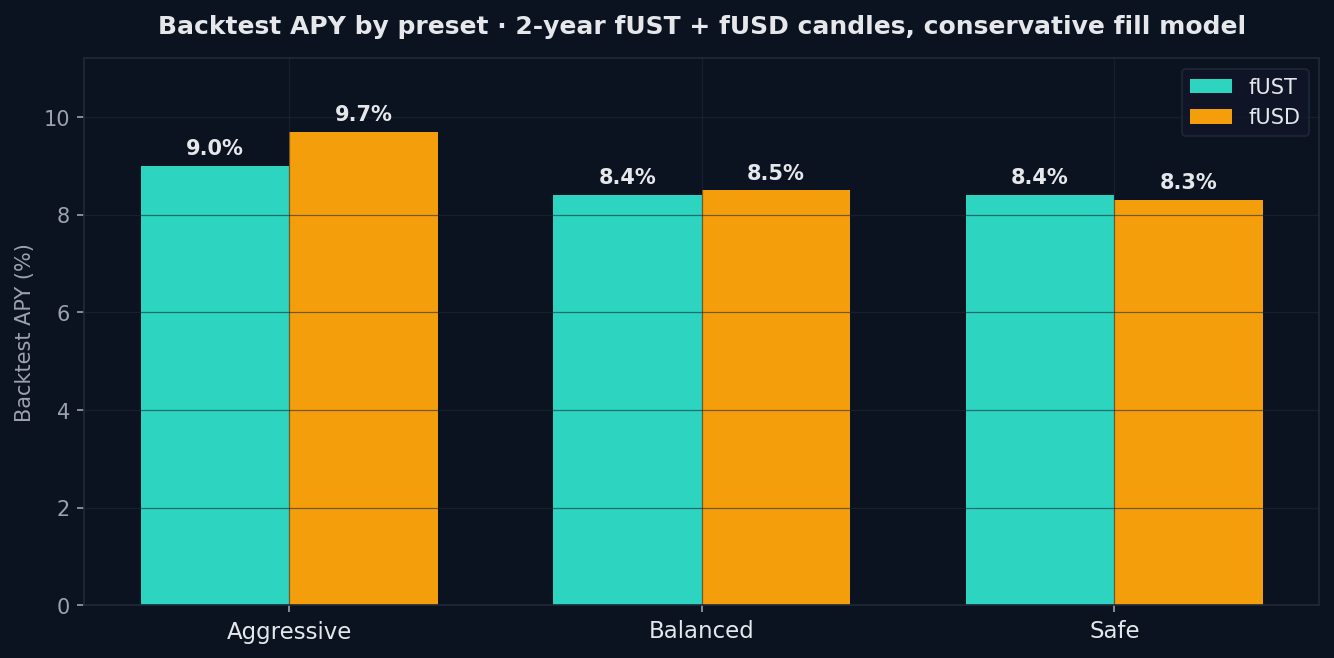
- Aggressive — reserve=0, full deployment. fUST 12.8% / fUSD 13.6% (70% of walk-forward median; raw median 18.3% / 19.4%).
- Balanced — 10% reserve, proportional grab. fUST 12.8% / fUSD 13.6% (highest fUSD top-3 stability at 90%).
- Safe — 30% reserve, highest stability. fUST 12.5% / fUSD 13.1%, gives up some yield for stability.
All three presets share the same robust floor + allocation shape (floors={short:6%, mid:8%, long:12%, xlong:15%}, alloc={0.2, 0.3, 0.3, 0.2}); they differ only on reserve_pct and grab strength. This shape is the joint optimum across 5.5 years of 58 walk-forward windows for both fUSD and fUST.
Each preset slices the wallet differently across the four buckets and an optional spike reserve:
Backtests use a realistic fill model: candle.high gate + transient-spike filter + prepayment hazard + depth gating + 5.5-year walk-forward cross-validation (180d train / 90d OOS test, rolling 30d). Backtest is based on 2020-11 → 2026-04 historical data and does NOT guarantee future returns — market regime shifts, rate ranges change, and live results may run higher or lower than this estimate.
You bring your own API key (funding-only — no withdraw permission allowed), we run the strategy, your USDT never leaves your exchange account. The free plan is permanently available (up to 500 USDT managed); beyond that it’s 30 USDT per year, or sign up through our affiliate link, submit proof, and after review you get permanent 50% off (15 USDT per year).
Frequently asked questions
Is this funding market safe?
Your USDT stays in your own funding wallet for the entire loan period; you’re not transferring custody to anyone. The risks are: (a) the venue’s platform/insurance-fund risk, the same as holding any balance on the exchange; (b) borrower default — historically negligible because borrowers post margin collateral that the platform liquidates if they fall behind. There has been no widespread principal-loss event for funding lenders since the platform launched.
What is the realistic APY on this funding market?
Walk-forward backtest median across 5.5 years (balanced preset, λ=1.0 calibrated): fUSD ~15.7%, fUST ~16.0% net of the platform’s 15% fee. Marketing pages quote a deliberately lower 12-15% range to leave headroom for live execution. Spike windows can briefly push past 25-30% APR. See the full backtest post (linked below) for distributions.
Do I need a bot, or can I do this manually?
Manually possible but it’s a 30-min/day routine: cancel stale offers, reprice, watch for spikes. The ~180 hours/year of attention is the real cost. A bot reprices every 60 seconds and catches spikes that happen at 3 AM your time. Manual users typically realize 4-7% APY (capturing the median, missing the spikes); bot users realize the full distribution.
How is this funding market different from Binance Earn?
Binance Earn is a pooled product where Binance sets the rate and keeps most of the spread (estimated 80-90% retention). This funding market is peer-to-peer matching with a documented 15% platform fee — the other 85% is yours. Same underlying margin demand, very different yield: typically 5-10× difference in user APY. See the side-by-side.
What capital do I need to make this worthwhile?
The venue’s offer minimum is $150. Below ~$1K, bot fees dominate. The sweet spot is $5K+, where flat-fee bots become materially cheaper than performance-fee competitors. See yield by capital size for the breakeven math.
Can I lose money on this funding market?
Yes — three failure modes: (1) opportunity cost if rates drop while you’re locked into a long period; (2) platform risk (insurance fund coverage but no FDIC equivalent); (3) the borrower’s collateral fails to cover the loan during a violent crash before liquidation triggers (rare but non-zero). Past performance does not guarantee future returns.
Deep dives
This is the overview. If you want to drill into a specific aspect, here’s the rest of the library:
- Funding APR explained — full breakdown of FRR, periods, hidden offers, and how the venue’s 15% take changes net yield
- 5.5-year walk-forward backtest — methodology and the real OOS distribution behind the 12-15% APY claim
- Funding bot comparison 2026 — Coinlend / Cryptolend / Yieldsforge / EarnUSD / ALTINVEST head-to-head
- How to set up a funding-only API key — step-by-step, with the security gotchas
- Why long-term Coinlend users churn — the structural reasons behind the migration to flat-fee bots
TL;DR
If you’ve been parking USDT in Binance Earn at 5% and felt like you’re leaving money on the table — you are. This funding market’s median APR is 9% and tail spikes to 100%+. The catch is you need to run a bot to actually capture it, because the alpha is in the spikes, not the median.
A 7-day free trial is enough to see your own wallet’s numbers. Start here — Google sign-in only, no credit card.
This is a technical note, not financial advice. Funding markets involve market risk. Past backtest performance does not guarantee future returns.
Want to put your USDT on autopilot?
Free plan available forever. No credit card required.
Get started free